
The international residential real estate sector is undergoing a profound operational shift driven by the convergence of generative artificial intelligence, spatial computing, and evolving cross-border buyer expectations. Historically, purchasing pre-construction or off-plan residential properties across global markets required buyers to make major financial commitments based on static two-dimensional floor plans, static architectural renderings, and physical sample boards displayed in localized sales centres. This traditional sales model frequently created a cognitive gap between conceptual design and lived experience, often resulting in extended sales cycles, buyer hesitation, and expensive post-construction modification requests.
The emergence of generative AI platforms is redefining this paradigm by introducing active spatial co-creation into the global home-buying experience. Rather than acting as passive consumers choosing from rigid, pre-selected finishing packages, prospective purchasers worldwide are empowered to interactively configure, modify, and personalize their future living environments in real time. For international real estate platforms, property developers, and agencies such as InOut Properties, embedding generative AI into pre-construction marketing and architectural design represents a crucial strategic evolution that accelerates sales velocity, mitigates operational risk, and unlocks measurable value throughout the property lifecycle.
The Global Expansion of Generative AI in Pre-Construction Real Estate
The rapid adoption of generative AI within property technology (PropTech) reflects a broader structural transformation across worldwide property markets. The global market for generative AI in real estate was valued at $488.06 million in 2025 and reached $544.29 million in 2026, with financial forecasts projecting expansion to $1,427.36 million by 2035 at a compound annual growth rate (CAGR) of 11.33%. Wider technology valuations indicate that the broader global AI real estate software market reached $303 billion in 2025, supported by $16.7 billion in venture capital funding allocated to PropTech platforms. While North America represents over 41% of global revenue share, deployment is global, with cloud-based infrastructure accounting for more than 60% of technical implementations worldwide.
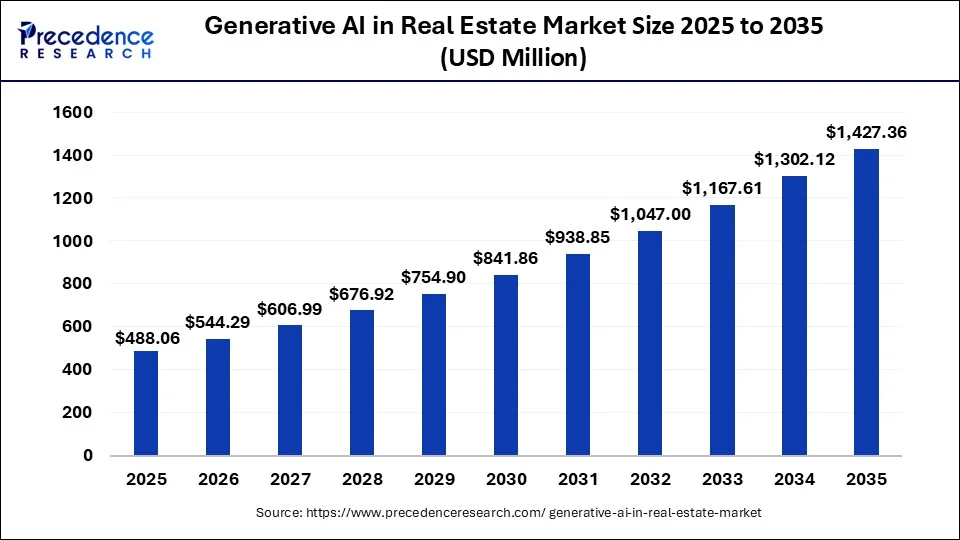
Industry survey data reveals that artificial intelligence has transitioned from experimental pilot projects into indispensable core infrastructure. Global assessments indicate that 68% of real estate professionals actively utilized AI tools in 2025, an adoption rate that expanded past 82% by early 2026. Concurrently, 88% of institutional real estate owners and asset managers globally report piloting generative AI applications across their international property portfolios. On a global macroeconomic scale, research indicates that generative AI and autonomous agent systems contribute between $430 billion and $550 billion in annual value to the global real estate and construction sectors. Capital allocation further confirms this trajectory, with corporate investments in generative AI real estate software surpassing $3.5 billion over a thirty-month period.
This rapid market expansion is driven by universal pressures facing international residential developers. Inflationary pressures, fluctuating material costs, and strict financing criteria have tightened developer margins across major global urban hubs. Simultaneously, international buyers seeking primary residences, holiday homes, or cross-border investments demand absolute design certainty and alignment with personalized lifestyle preferences before committing capital. Generative AI solves both challenges simultaneously: it drastically reduces visual production costs while delivering hyper-personalized, photorealistic experiences that turn global prospects into confident buyers.
Technical Architecture of Neural Rendering and Dynamic Spatial Customization
Dynamic interior personalization relies on an advanced technology stack that unifies computational geometry, computer vision, and neural rendering engines. Rather than relying on static image libraries, generative AI platforms ingest core architectural data—such as 2D vector CAD files and Building Information Modelling (BIM) datasets—to synthesize immersive 3D environments dynamically.

Computer Vision and Diffusion-Based Surface Synthesis
At the heart of real-time interior customization are computer vision algorithms paired with latent diffusion models. When a global buyer accesses a digital twin of a pre-construction property through an interactive browser or mobile device, these algorithms analyze the room geometry, evaluating parameters such as ceiling heights, window proportions, structural pillars, and natural light direction. Purchasers can enter natural language prompts or select visual themes to instantly re-style interior surfaces and layout elements.
For example, a prospective buyer requesting a switch from a warm Scandinavian aesthetic to a sleek urban industrial look featuring exposed brick, polished concrete floors, and matte black fixtures triggers the diffusion model to re-render textures in real time. The system maintains strict lighting and perspective models, ensuring that shadows, material reflections, and scale conform to physical reality. Cloud-based execution allows these photorealistic visuals to be rendered in under ten seconds per iteration without requiring specialized hardware on the user's side.
Structural Feasibility and Engineering Verification
A core challenge in flexible spatial customization is ensuring that buyer-driven modifications remain structurally viable and compliant with building standards. Advanced generative systems address this by incorporating Graph Neural Networks (GNNs) and neural surrogate models that execute real-time structural and code validation checks.
When an international client attempts to modify an interior layout—such as removing a wall to create an open-plan kitchen and living space—the surrogate model evaluates building performance parameters. The algorithm instantly identifies whether the wall houses structural load-bearing components, plumbing stacks, or electrical risers. If a requested layout change violates engineering codes or exceeds safe structural spans, the AI automatically proposes compliant design alternatives, such as introducing a non-structural partition or altering furniture positioning. This automated validation prevents unconstructible designs from advancing to contracting.
Dynamic Bill of Materials and Financial Transparency
Spatial customization platforms bridge visual aesthetics with financial accuracy by linking design selections directly to automated cost models. As purchasers select premium finishes, upgrade cabinetry materials, or reconfigure lighting schemes, the software continuously updates an embedded Bill of Materials (BOM).
This integration provides transparent, itemized pricing breakdowns to the buyer in real time. The platform calculates exact material quantities, labour expenses, and developer margins. This removes the uncertainty associated with traditional design centre appointments, enabling global buyers to customize their future homes within precise budget boundaries. Furthermore, early optimization during pre-construction helps eliminate material waste, directly addressing industry data showing that up to one-third of total construction waste stems from pre-construction over-specification and design inaccuracies.
Quantitative Business Impact and Operational ROI for Developers
Implementing generative AI co-creation tools yields quantifiable financial and operational advantages across international property development, sales, and marketing. The table below illustrates the key performance gains when transitioning from traditional pre-construction sales to AI-driven active co-creation environments.
| Performance Dimension | Traditional Pre-Construction Workflow | AI-Enabled Active Co-Creation Workflow | Operational Variance and Impact |
| Design Revision Timeline | 2 to 4 weeks per drafting iteration via manual architectural review | Real-time visual iterations in under 10 seconds | 37% overall reduction in design revision cycles |
| Purchaser Satisfaction | Static 2D floor plans causing misaligned spatial expectations | Interactive photorealistic navigation of dynamic digital twins | 28% increase in buyer satisfaction scores |
| Virtual Staging Costs | High physical staging costs per model unit | Cloud-rendered virtual staging and instant material swaps | 70% to 80% reduction in staging and asset production costs |
| Lead-to-Visit Conversion | Static photo galleries and delayed follow-ups | Interactive discovery feeds with direct 3D spatial customization | Up to 200% increase in qualified property visit requests |
| Valuation Error Margin | Manual appraisals with 5% to 15% variance | Automated Valuation Models with computer vision analysis | Reduced error margins down to ~3% |
| Inquiry Response Speed | Average manual response time exceeding 15 hours | Automated conversational AI with responses under 5 minutes | Up to 9x lift in lead conversion rates |
The commercial imperative for active co-creation extends directly to presale velocity. Institutional lenders worldwide typically require developers to reach significant presale targets before releasing construction capital. Generative AI tools accelerate buyer commitments by fostering psychological ownership early in the sales journey. When prospective buyers actively shape their interior layout, experiment with finishes, and view custom lighting configurations, their emotional investment increases significantly. This connection shortens deliberation periods and raises closing rates for international developments.
Administrative overhead is reduced simultaneously. Traditional customization workflows demand continuous coordination between real estate agents, interior designers, engineers, and supply chain managers. By automating layout validation, cost estimation, and visual rendering into a single unified workspace, property developers eliminate operational bottlenecks. Architectural teams are freed from repetitive drafting tasks, allowing them to focus on overarching design quality and site execution.
Global Market Engagement: Cross-Border Sales, Multilingual Support, and Privacy
Deploying generative AI co-creation portals across global markets requires addressing cross-border buyer demographics, multilingual communication, and international data standards.
Multilingual Interfaces for International Buyers
International real estate markets rely heavily on remote and cross-border buyers seeking properties across major global capitals and luxury resort destinations. To capture global market share, PropTech platforms must offer frictionless multilingual capabilities. Leading AI property portals now integrate natural language processing supporting over 20 languages—including English, French, Spanish, Mandarin, Hindi, German, and Arabic.
In multi-jurisdictional sales environments, AI portals allow an overseas buyer to input natural language prompts in their native language while automatically generating standardized, localized technical documentation for on-site construction managers and contractors. This eliminates translation errors and streamlines communication between buyers, agents, and construction teams.
Global Data Privacy Governance
Dynamic customization platforms gather granular user preference data, tracking specific finish choices, lifestyle constraints, spatial preferences, and engagement time. Operating on a global scale requires strict adherence to international data privacy frameworks, such as the European Union’s General Data Protection Regulation (GDPR) and regional data protection acts.
Compliance requires robust data architecture, clear privacy disclosures, and explicit opt-in consent for telemetry gathering. Personal identifiers must be encrypted, and machine learning models analyzing buyer preferences must run on anonymized datasets to prevent user re-identification while continually improving AI design recommendations.
Risk Mitigation, Algorithmic Constraints, and Architectural Feasibility
While generative AI offers massive opportunities for spatial co-creation, enterprise deployment requires active management of technical liabilities, rendering accuracy, and design integrity.
Eliminating Neural Hallucinations and Unfeasible Visuals
A primary technical risk in unconstrained generative rendering is the occurrence of neural "hallucinations"—where diffusion models produce impossible physical geometries, non-standard structural elements, or unproducible lighting conditions. If an overseas buyer makes a financial commitment based on an unbuildable AI image, the developer faces serious legal liability and brand damage.
To neutralize this risk, PropTech platforms utilize hybrid constrained architectures. Generative diffusion models are strictly bounded by underlying 3D parametric CAD models and verified manufacturer product catalogues. In this framework, the generative AI serves as a high-speed photorealistic visualization layer over engineered, buildable architectural foundations. Human architectural sign-off remains an essential final checkpoint before customization choices are finalized into binding construction contracts.
Preventing Design Homogenization and Cultural Bias
AI algorithms trained predominantly on specific regional design datasets can exhibit stylistic bias, failing to accommodate diverse cultural preferences for room layout, kitchen functionality, or spatial flow. Real estate firms operating globally must ensure AI models are trained on diverse, international design libraries to deliver culturally inclusive spatial options.
Furthermore, over-reliance on automated design tools risks visual homogenization across competing property developments. Maintaining strong collaboration between generative platforms and human interior designers ensures that each project retains distinct aesthetic character, local architectural context, and unique brand identity.
Strategic Roadmap for InOut Properties and the Future of Real Estate
The shift from static real estate marketing to active buyer co-creation represents a permanent transformation in how homes are designed, marketed, and sold globally. Generative artificial intelligence has evolved from a visual marketing add-on into a critical operational engine that unifies consumer preference, spatial design, structural engineering, and real-time financial modeling.
For global real estate platforms like InOut Properties, success requires a disciplined technical roadmap. Developers must prioritize hybrid generative AI platforms constrained by BIM geometry and manufacturer catalogues to ensure visual customization remains 100% buildable. Platforms must provide real-time dynamic pricing transparency to buyers while maintaining operational cost controls for development partners. Finally, systems must incorporate multi-lingual engagement and strict global data privacy standards to serve an increasingly interconnected, international buyer base.
By giving global buyers active agency in co-creating their living spaces, forward-thinking real estate leaders can eliminate pre-construction sales friction, accelerate global presale velocity, and deliver living environments tailored to the modern international lifestyle.